 ,
, ABU DBS 2026: DAB+ in the Rising Synthetic Era: from innovation to implementation
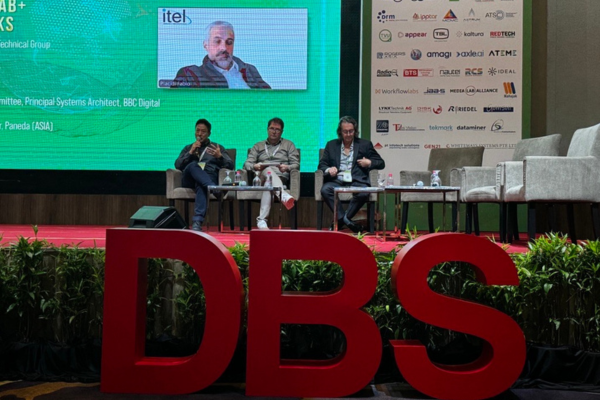
At this year’s Asia-Pacific Broadcasting Union Digital Broadcasting Symposium (ABU DBS 2026), the theme — “The Rising Synthetic Era” — captured a defining moment for the broadcasting industry.
Artificial intelligence is reshaping how content is created, discovered and distributed. Across Asia-Pacific, broadcasters are navigating a more complex landscape: fragmented audiences, new listening environments, and rising expectations around accessibility and personalisation. But alongside this transformation, a more fundamental question is emerging — how to ensure that trusted, universally accessible media continues to reach audiences at scale.
This was the thread running through WorldDAB’s contribution to the conference.
From innovation to infrastructure
In his presentation, Lindsay Cornell (BBC) demonstrated how DAB+ continues to evolve as a mature and adaptable platform for digital radio.
He highlighted the now extensive coverage of most of Europe and the expanding coverage in the Asia-Pacific and Africa. He emphasised that DAB+ is an evolving standard with new enhancements such as improved text handling, localisation features and service following which are extending listener choice while supporting local relevance.
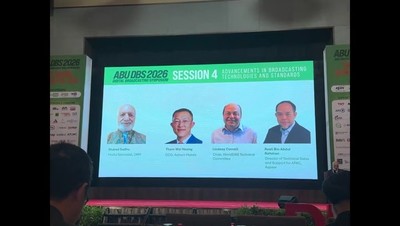
Lindsay Cornell, Chair, WorldDAB Technical Committee spoke at ABU DBS 2026
DAB+ is no longer simply a digital alternative to analogue radio. It is increasingly positioned as the backbone of broadcast radio — combining scale, efficiency and flexibility in a way that allows markets to adapt to their own needs.
This adaptability is particularly important in Asia-Pacific, where market conditions and regulatory frameworks vary widely.
Trust and resilience in a changing landscape
If the conference theme focused on AI-driven innovation, Dr Les Sabel’s presentation highlighted radio’s enduring strengths.
In times of crisis, radio remains one of the most reliable forms of communication. DAB+ networks are designed with resilience at their core, incorporating redundancy across transmission systems, multiplexing and distribution. The Automatic Safety Alert (ASA) system further strengthens this capability, enabling targeted emergency warnings even when other mobile and telecommunications networks fail, in some cases for several days or more.
In an increasingly complex and digital environment, this ability to deliver trusted, reliable information is more important than ever.
Policy as the enabler of success
Bernie O’Neill (WorldDAB) focused on a critical enabler of successful deployment: public policy.
While DAB+ is well established in Europe and gaining momentum globally, its success is not automatic. Markets transition through deliberate policy choices that shape market conditions, reduce investment risk and enable coordination between stakeholders.
In Asia-Pacific, where markets differ significantly, there is no single model. But there are common principles. To support this, WorldDAB is launching the DAB+ Public Policy Toolbox, providing practical guidance to help governments and regulators design effective digital radio strategies. The DAB+ Public Policy Toolbox will be launched on 19 May, and featured at WorldDAB Automotive on 11 June in Frankfurt.
Hybrid radio and the role of metadata
Nick Piggott (RadioDNS) highlighted the growing importance of hybrid radio and metadata.
As listening shifts towards connected environments, particularly in vehicles, metadata plays a central role in how radio is discovered and experienced. The combination of broadcast and IP enables richer services while preserving the strengths of broadcast delivery.
Radio is strongest when broadcast and IP work together — ensuring it remains visible, accessible and competitive in modern interfaces.
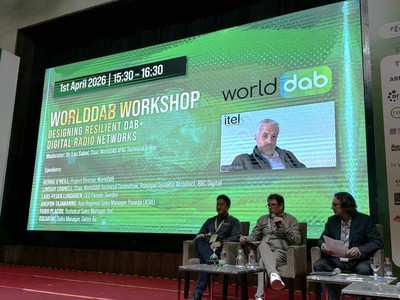
The WorldDAB workshop at ABU DBS 2026
From strategy to implementation
While the conference sessions explored why DAB+ matters, the WorldDAB workshop focused on how to make it work in practice.
Opening the session, Bernie O’Neill highlighted the gap that many markets face between strategy and implementation. Policy provides the framework, but successful rollout depends on detailed planning, coordination and technical expertise.
Through its technical groups and the Spectrum and Network Implementation Committee, WorldDAB supports this process by sharing practical experience and deployment guidance.
Different markets, shared direction
The workshop provided insight into how this plays out across Asia-Pacific.
Thailand’s approach combines technical trials, regulatory development and industry consultation, with steady progress in coverage, metadata integration and service functionality. Indonesia, meanwhile, is moving from trials towards national implementation, supported by a formal Digital Sound Broadcasting framework and expanding transmission infrastructure.
While the paths differ, the direction is shared — greater capacity, improved efficiency and a future-proof platform for radio.
Designing networks for the real world
A panel discussion on network design brought practical insights into focus.
Energy efficiency often comes from optimising transmission systems rather than over-engineering entire networks. At the same time, complexity can become a risk if redundancy is applied without careful consideration.
Audio quality also emerged as a critical factor. Poor input sources, incorrect processing and latency can significantly impact the listener experience, even where networks are otherwise performing well.
The strongest message, however, was around resilience. Increasingly, resilience must be designed into the system from the outset — across transmission, multiplexing and distribution. Redundancy, diverse signal paths and automated failover are now fundamental requirements.
At the same time, resilience must be balanced with cost. A phased approach allows networks to evolve over time, aligning investment with audience growth while maintaining reliability.
Technology and economics: supporting sustainable rollout
Ongoing technical developments continue to support implementation, with updates to DAB+ standards improving flexibility, localisation and user experience.
From an economic perspective, DAB+ remains a highly efficient and cost-effective platform for radio. Comparisons with emerging technologies such as 5G Broadcast underline its strengths in both cost and resilience. While new technologies may complement broadcast, they do not yet provide a viable alternative for large-scale, free-to-air radio delivery.
From insight to action
Across both the conference and the workshop, a consistent message emerged. The future of radio depends not only on innovation, but on how effectively it is implemented.
DAB+ provides a platform that combines scale, reliability and flexibility — but its success depends on strong policy, practical expertise and collaboration across the ecosystem.
There is no one-size-fits-all model. Yet the direction is clear.
In that sense, the conversation at ABU DBS 2026 was not just about the future of radio — but how to build it successfully.
About the author:
Dr Les Sabel, S-Comm Technologies (Chair, WorldDAB APAC Technical Group)
Dr Sabel has over 30 years of experience in communications systems, including broadcast digital radio (DAB/DAB+ and DRM), mobile communications, wireless broadband, and satellite communications. A technical expert on DAB+, he provides independent engineering consultancy to WorldDAB, the ITU and broadcasters, regulators, network operators and equipment suppliers in Australia, Southeast Asia and around the globe. The Asia-Pacific Technical Group meets 2-3 times a year and gives guidance on the technical aspects of implementing DAB+ digital radio, with help and advice that is tailored specifically to the needs of the APAC region.