
Comparing DAB+ experiences – Ensemble pour le DAB+ & MaRadio.be
04.02.2026 by Bernie O'Neill
One of the most valuable discussions on DAB+ at Paris Radio Show was not about transmitters, coverage maps or standards, but about how DAB+ is communicated, promoted and embedded across an entire radio ecosystem.
Bringing together perspectives from Belgium and France, the session highlighted that a successful digital radio adoption depends as much on strategy, coordination and messaging as it does on infrastructure.
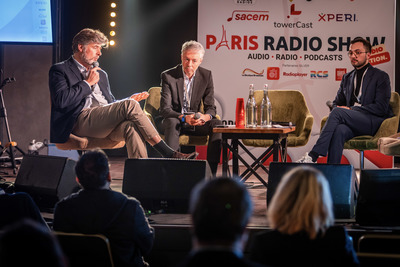
From left: Frédéric Gérand, RTBF; Charles-Emmanuel Bon, Radio France; Maëlo Seuret, Ensemble pour le DAB+, on stage at Paris Radio Show 2026. Photo: Hervé Thouroude
Belgium: from promoting radio to shaping the ecosystem
In Belgium, the approach to DAB+ promotion has evolved significantly over the past decade. Rather than focusing narrowly on DAB+ as a technology, the Belgian model has broadened to promote digital radio as a whole, integrating both broadcast and IP distribution into a single narrative.
This shift has also expanded the organisation’s role — from marketing radio to engaging more directly with regulatory frameworks, market measurement and long-term transition planning. Importantly, Belgium has avoided setting a fixed FM switch-off date. Instead, the conversation is framed around clear KPIs.
The logic is pragmatic: when only around 10% of listeners remain exclusively on FM, it becomes realistic to consider a managed, multi-year transition process. Until then, the focus remains on growing digital listening and building confidence across the market.
This evolution is reflected in Belgium’s communication strategy. Recent campaigns no longer reference DAB+ or IP explicitly, but instead promote “digital radio” under the banner Écoutez avec vos oreilles (“Listen with your ears”). The aim is simplicity — focusing on the listener experience rather than the underlying technology. Campaigns have three focus targets, including the younger generation, each with tailored messages.
France: creating awareness in a larger market
France presents a very different challenge. DAB+ arrived later, in a country with vast geography, strong legacy FM usage and high market complexity. The rollout strategy began in major cities such as Paris, Lyon and Marseille, and has now progressed to a national network targeting around 80% population coverage by the end of 2026, broadly equivalent to FM.
At the start of this journey, public awareness of DAB+ was extremely low — around 5%. Addressing that awareness gap became the first priority. Coordinated national campaigns, running several times per year and reaching tens of millions of people, have delivered measurable impact. Within a year, awareness rose from around 20% to 35%, demonstrating that sustained, consistent communication works.
At this stage, France remains firmly in the installation and awareness phase. The emphasis is on ensuring that radio listeners — particularly those buying new receivers — understand what DAB+ is, what to look for, and why it matters. The messaging focuses on digital broadcasting, continuity of service (especially in cars), and improved robustness, rather than on switch-off timelines.
Promotion beyond radio spots
A key question raised during the session was how DAB+ is promoted beyond traditional on-air advertising.
In France, broadcasters tailor their messaging carefully to different audiences and stations. Examples ranged from longer-form campaigns highlighting listening continuity on motorways, to shorter, station-specific messages explaining network expansions, new cities coming on air, and the practical benefits of DAB+. Crucially, these campaigns demonstrate that the same technology can be framed differently depending on audience and context.
Belgium has taken a complementary approach by focusing heavily on internal education. Broadcasters, journalists and presenters are actively briefed on DAB+ so that they can explain it confidently and naturally on air — and, just as importantly, stop defaulting to FM-centric language. The objective is cultural as much as technical: making digital radio the assumed norm.
Inside the radio groups: leading by example
Both markets emphasised that DAB+ promotion cannot be outsourced solely to marketing campaigns — it must also happen inside radio organisations themselves.
In Belgium, this includes coordinated listener competitions, supported by a central budget to purchase and distribute DAB+ receivers across stations. While moving away from FM language remains challenging, sustained engagement with station teams helps presenters speak knowledgeably and consistently about digital radio.
At Radio France, every station has a responsibility to promote DAB+, with the emphasis is on digital modernisation, improved sound quality, resilience and reach — particularly in the car — and on supporting colleagues across the group in a collective effort to future-proof radio.
One conclusion stood out clearly: DAB+ is not just a technology upgrade — it is a collective, long-term project. Whether in Belgium, France or emerging markets, success depends on coordination, shared messaging, realistic expectations and a willingness for all actors - broadcasters, regulators, manufacturers and platforms - to move forward together. Only then can DAB+ deliver on its promise of resilience, plurality and long-term relevance.
Posted in:


