 , Automotive
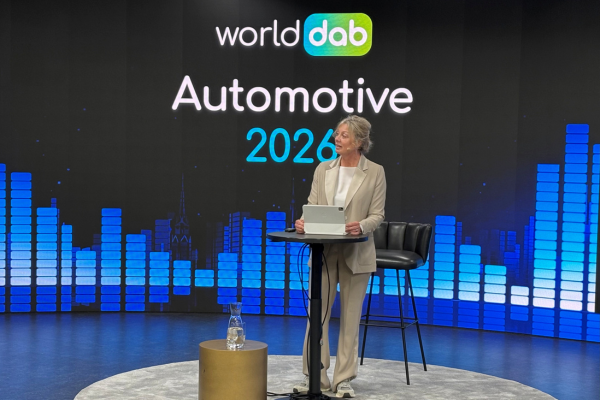
WorldDAB Automotive 2026: Jacqueline Bierhorst
Good morning everyone.
Welcome to Frankfurt — and herzlich willkommen.
It is a real pleasure to welcome you once again to WorldDAB Automotive.
This event is special because it brings together the full ecosystem that shapes the future of radio in the car: broadcasters, car makers, chip manufacturers, technology providers, regulators and policymakers.
For drivers, broadcast radio remains one of the most important and valued media in the car. It is immediate, trusted, familiar and easy to use. It is where people turn for music, news, traffic, weather, company, reassurance and, when needed, urgent information.
And because it is broadcast, it has qualities that matter deeply in the car. It is free-to-air. It does not require a login, a subscription or a data plan. It can reach everyone at the same time. And it remains resilient when networks are congested or unavailable.
IP and connected services can add great value, but broadcast remains the foundation that keeps radio universally available for drivers.
For broadcasters, the car is therefore essential. And for the automotive and technology sectors, broadcast radio is not a legacy feature, but a core part of the in-car experience that drivers still expect to be present, easy to find and simple to use.
And that is why this event matters.
We meet at a time when the dashboard is changing fast. The car is no longer just a vehicle with a radio receiver. It is becoming a connected, software-driven environment shaped by operating systems, apps, platforms, voice assistants, algorithms, subscription models and user-interface decisions.
That brings enormous opportunity. But it also brings risk.
Because if we are not careful, broadcast radio — one of the most used, trusted and expected services in the car — can become harder to find, harder to use, or less visible than it should be.
That is not a small design issue.
It is a listener issue.
It is a broadcaster issue.
It is an automotive user-experience issue.
And increasingly, it is also a public policy issue.
This is why broadcast radio, and in particular DAB+, remains so important.
DAB+ provides a strong, modern broadcast foundation for radio in the car. It supports free-to-air access, reliability and a high-quality listener experience. It also sits naturally alongside IP, apps and connected services.
The future of radio in the car is not a choice between broadcast and IP. The strongest future is hybrid: broadcast where broadcast is best, IP where IP adds value, and a user experience that makes radio easy, prominent and reliable for the listener.
That is also why WorldDAB is committed to playing its part in Radio Ready’s unified vision for connected cars: ensuring that radio remains accessible, prominent and discoverable in modern vehicles.
These questions are not theoretical. They are already shaping the dashboard.
Metadata matters.
Defaults matter.
Search matters.
Voice matters.
The position of a radio icon on a screen matters.
The difference between a seamless journey and a frustrating one matters.
Good radio UX does not happen by accident. It requires collaboration between broadcasters, car manufacturers, chip manufacturers, technology providers, platforms, regulators and policymakers.
That collaboration is exactly why we are here today.
We also meet at an important policy moment.
In Europe, the Digital Networks Act discussion gives us an opportunity to build on the success of the European Electronic Communications Code, which has already had a major impact on the uptake of DAB+ in cars.
The lesson is clear: public policy can make a real difference. It can support universal access. It can protect listener choice. It can ensure that trusted, free-to-air radio remains available in vehicles.
Later today, we will also discuss the DAB+ Public Policy Toolbox. This is an important new resource for governments, regulators and industry. It helps markets move from uncertainty to action by identifying the right policy levers for their own national situation: planning, licensing, transmission, reception, incentives, coverage obligations, receiver regulation, emergency warning capability and industry coordination.
That is exactly the kind of practical support markets need.
At the same time, we should recognise that every market follows its own path.
Switzerland is a useful reminder of that. FM switch-off can bring clear benefits, especially in reducing the cost of parallel distribution. But switch-off is not the only measure of DAB+ success. What matters is that DAB+ remains firmly established, with strong listener adoption and continued broadcaster commitment. That helps create a healthier and more sustainable market position for radio.
Our role is not to force every country into the same model. Our role is to support each market in building a sustainable digital radio future that works for broadcasters, listeners, car makers and society.
And there is strong momentum.
Germany, our host country today, remains an important DAB+ market in Europe, where automotive, broadcast, public policy and ASA are coming together in a very practical and forward-looking way.
Beyond Germany, around 60 countries are now engaged with DAB+ in some form — from early exploration and trials to mature, fully integrated digital radio markets.
This shows that DAB+ is not a one-size-fits-all story. It is a flexible, proven digital broadcast technology that can support different national circumstances, different policy models and different stages of market development.
WorldDAB’s role is to connect these experiences.
To share evidence.
To bring together public and commercial broadcasters.
To bring together broadcast, automotive and technology.
To help countries learn from one another.
And to make the case, clearly and confidently, for DAB+.
Our infographic is the one place for all the DAB+ facts and figures. We are publishing an updated edition today.
I can reveal that our latest update shows there are now over 166 million DAB devices sold. That’s a full ten percent increase since we last compiled the figures in February 2025. Real momentum.
Today, we will add another important piece of evidence.
This morning, we will unveil new car buyer research from Fifty5Blue, covering six significant automotive and radio markets: Australia, France, Germany, Italy, Spain and the UK.
We know that broadcast radio is deeply embedded in the in-car experience. Drivers value it. They expect it. They use it. They see it as part of what a car should offer.
But the dashboard is changing fast, so we need fresh evidence: how drivers use audio in the car today, what they expect, what they find easy or frustrating, and how prominence, defaults and user experience influence behaviour.
That evidence matters. If we want broadcast radio to remain strong in the car, we need more than belief. We need proof, practical tools, shared language and coordinated action.
That is what today is about.
It is about confidence — because radio remains strong.
It is about urgency — because the dashboard is changing.
And it is about collaboration — because no single part of the ecosystem can solve this alone.
I want to thank our speakers, our sponsors, our exhibitors, our members, the WorldDAB Project Office, and all of you for being here in Frankfurt.
Thank you for bringing your expertise, your questions and your commitment.
I hope today gives all of us renewed energy and confidence to keep broadcast radio — powered by DAB+ — strong where it matters so much: in the car, for listeners, and for society.
Thank you — and enjoy today’s event.