
The choices we make today. The radio we hear tomorrow.
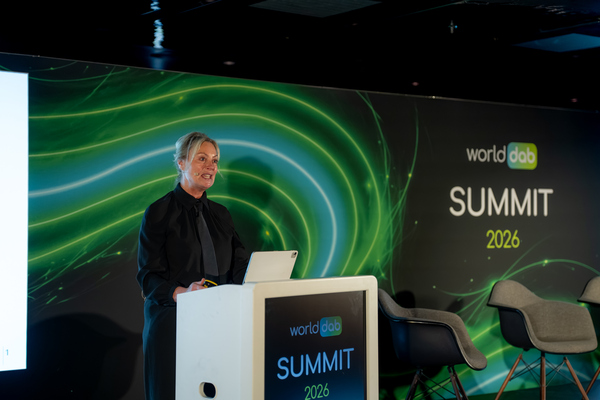
Good morning, everyone, and herzlich willkommen in Wien!
It is wonderful to see you here. A warm welcome to our members, our partners, and everyone joining the WorldDAB Summit for the first time.
It was lovely to see so many of you at K47 last night, with those wonderful views over Vienna. An evening like that reminds us how much we value the chance to spend time together and catch up beyond our usual meetings.
Vienna is a city that knows the power of sound. And Austria gives us plenty to talk about. Its commercial broadcasters are helping drive DAB+ growth, bringing new services and more choice to listeners. Alongside that, ORF has launched a DAB+ pilot of Hitradio Ö3.
Thank you to Digital Radio Austria for supporting this Summit, and to our Austrian colleagues for welcoming us. We will hear more about their experience today.
Before we turn to today’s programme, I would like to recognise Bernie O’Neill, who will leave WorldDAB at the end of December after sixteen years as Project Director. Yesterday, she received our Award for Outstanding Service. We will celebrate her contribution more fully at the close of today’s Summit. But first, Bernie, thank you, and congratulations once again.
I would like to begin with a question. Ten years from now, what place do we want broadcast radio to have in people’s lives?
And what choices do we need to make today to help it get there?
A global story, led by countries
This year, my role as WorldDAB President has taken me to places as different as Croatia, Saudi Arabia, Indonesia and Lithuania.
Different countries, different circumstances, different stages of digital radio development. One thing is the same though. Those visits have reminded me how relevant radio is, and how much people care about its future.
In a world that can feel uncertain, radio offers a connection to the place where you live. A familiar voice. The news you need. Music, company, and sometimes reassurance when you need it most.
Around a third of the world’s countries are now engaged with DAB+ in some form. That includes early interest and trials, established services and, in some markets, switching off FM.
Estonia has launched regular services. Czechia and Croatia are developing their markets. Kenya has moved from preparation to an on-air trial, Senegal has launched 18 public services on air, while Thailand has extended trial coverage and did an ASA test on 29 October. I'm particularly pleased that we will hear from Poland today. Konrad, thank you for joining us to share the progress being made and the next steps for DAB+ in your country.
Behind each step are people making it happen in their own country. The credit belongs to them. Our role is to connect that experience and help others take their next step.
What will “radio” mean in ten years?
And perhaps, in ten years, people will mean something different when they say “radio”.
The experience may become more personal and more interactive. It may include pictures, a conversation with a voice assistant, or services we have not yet imagined. We should be excited about that.
The next generation will discover radio in its own way. They will judge it by what it offers them and how easily it fits into their lives.
Within that changing experience, broadcast has something valuable to contribute: free-to-air access, the ability to reach millions at once, and reception that does not depend on every listener having an internet connection.
DAB+ gives us a foundation on which to keep building. Connected services can enrich the experience. New content can give people a reason to listen.
So as we imagine what radio might become, let’s ask which qualities we want everyone to continue to enjoy.
More choice can create more value
For broadcasters, this is also a question about building a sustainable business.
Digital distribution creates room for a successful brand to grow, for a different music format, for a service that speaks to an audience previously overlooked. That is where the opportunity becomes tangible.
The UK and the Netherlands provide encouraging examples. UK radio advertising revenues reached £747 million in 2025, up 39 percent since 2013. In the Netherlands, they reached €271 million, up 39 percent since 2016.
These are figures for the wider radio business. We cannot attribute that growth to DAB+ alone. But they show that radio can grow in a digital media market, and that a strong digital strategy can support that ambition.
As Chair of our Marketing Group, I also see how important it is to tell that story to listeners. More choice only makes a difference when people know what is available and how to find it. Broadcasters, manufacturers and retailers working together can help turn that opportunity into everyday listening.
Today, we will hear about building brands on DAB+ and new creative possibilities, including AI-generated sonic branding. I look forward to hearing what these ideas offer listeners, and how they help broadcasters create value.
A listener cannot choose what they cannot find
Of course, a wonderful service needs to be easy to find.
At WorldDAB Automotive in Frankfurt, our car-buyer research across six markets found that 83 percent of car buyers listen to radio in the car. That is a powerful reminder of how much drivers value it.
But dashboards are changing. Screens, apps and voice assistants influence what people discover and how easily they reach it.
For listeners, the experience should feel straightforward. They want their station to be there. Broadcasters, vehicle manufacturers and technology partners all have a part to play in making that happen.
Good metadata and clear station identities matter. So do design decisions about search and the radio prominence on the screen in a car dashboard.
The choices made now will shape listening habits for years. We should bring the evidence about what drivers value into those conversations, and make sure broadcast radio keeps a clear and accessible place in the car.
Make the next step possible
That is also why policy matters.
The Digital Networks Act discussion gives our industry an opportunity to explain why continued access to broadcast radio matters in future vehicles. I am delighted that Corinna Drumm from AER and Vincent Sneed from the EBU are here to explore what is at stake and how important collaboration is. And I look forward to joining Corinna and the EBU’s Wouter Quartier for a wider discussion about radio’s future.
WorldDAB works with partners to provide briefing materials, evidence and guidance that our members can use in their engagement with policymakers. National voices are essential: they connect the international case with the needs of their own country.
The Public Policy Toolbox serves a related purpose. It brings together experience from different markets, showing the policies and regulations used to support DAB+ development.
For a country considering its next step, that is a useful starting point. There is no need to invent every answer again. We can learn from what others have tried and adapt it to local circumstances.
Today’s case studies will help bring that experience to life.
A new reason for radio to matter
And there is another development that deserves our attention: Automatic Safety Alert.
In September, Deutschlandradio and Media Broadcast launched ASA DE on Germany’s national DAB+ network, working with the civil protection authority BBK.
With a compatible receiver, an urgent warning can wake a radio from standby and reach someone who was not already listening. Broadcast provides another route for vital information when mobile or internet connections are unavailable.
We will hear today about the experience in Germany and developments elsewhere. The work includes getting services, networks and receivers to operate together, and explaining the benefit clearly to the public.
For people choosing a receiver, this could be another reason to have a radio at home. For our industry, it is an opportunity to put a familiar technology to a new and valuable use.
The radio we hear tomorrow
So we have progress to celebrate and opportunities to explore. We also have questions that deserve honest discussion.
At last year’s Summit, I said our strategy remained clear: strengthening the core, expanding frontiers and securing automotive. That remains our focus, and the progress across our markets gives us a strong foundation to build on in 2027.
Tomorrow, we will be back in our offices, with full inboxes and the usual demands on our time. Today gives us a chance to look further ahead, and return with something useful.
I hope each of us leaves with one practical next step. An idea to test. A conversation to continue. Someone new to work with. Please make the most of the discussions, the exhibition and the people around you.
My thanks to our sponsors and exhibitors, our speakers, and everyone who has worked to bring us together.
The next generation will have plenty of choice about what to listen to. Our opportunity is to make sure there is wonderful radio for them to discover, and that it is easy for them to find.
The radio we hear tomorrow will be shaped by the choices we make today.
Let’s make the most of them. Thank you, and enjoy the Summit!