United Kingdom current situation
Status regular
Last update: 06.08.2026 - older versions
UK Radio Review 2026
In February 2026, the UK Government announced a new Radio Review. It said "the way people listen is rapidly changing. Almost 75% of UK radio listening now takes place on digital or online platforms, rather than FM and AM. To help the industry navigate this shift, the government will work with key partners, including the BBC and commercial radio, to examine changes in listener behaviour and audio markets in recent years, and make recommendations on the future distribution of radio services."
The review will consider:
- Whether there should be a managed transition away from FM in the 2030s and, if so, over what timescale;
- The potential impact of a decision on the future of Digital Terrestrial TV (DTT) on radio distribution;
- The role of emerging technologies, including Artificial Intelligence (AI), and the benefits and challenges they pose to the industry.
The Radio Review will conclude in autumn 2026 with a report to the government. This report will inform further policy development and the latter stages of the ongoing BBC Charter Review.
RAJAR audience data: over three-quarters of UK listening now digital
RAJAR produces an infographic showing key UK audience data.
Small-scale DAB
The small-scale DAB programme in the UK will enable the launch of around 100 or more multiplexes, covering all four UK nations. By September 2025, 75 multiplexes had launched, broadcasting a range of radio services, from grass-roots community services to specialist music stations, and services aimed at minority groups and other under-served audiences.
UK regulator Ofcom says "Small-scale DAB is an established technology which provides a low-cost way for local commercial, community and specialist music services to take to the digital airwaves."
In September 2025, applications opened for the eighth and final round of small-scale DAB radio multiplex licences, covering 40 areas across England, Northern Ireland, Scotland and Wales.
Read more about small-scale DAB licensing in the UK on the media regulator Ofcom's website. In October 2024, Ofcom published a progress update on its small-scale DAB roll-out across the UK.
United Kingdom coverage
Population 67.9 million
Population coverage 98%
Last update: 26.04.2021 - older versions
Current UK population coverage is:
- 98% for national BBC stations
- 91.5% for national commercial stations. National commercial stations launched across Northern Ireland for the first time in summer 2013
- 91% local DAB coverage
DAB coverage expansion
- A major two-year programme of DAB coverage build out has completed and included doubling the number of local DAB transmitters (around 200 new transmitters) to get local DAB to FM equivalence, over 162 new transmitters for the BBC national network to expand it from 95% population coverage to 97%, and more transmitters for the national commercial network, Digital One.
- The launch of 435 new national and local DAB transmitters bring 10 million more adults into coverage for local DAB stations and 1.5 million more adults into coverage for BBC national DAB stations.
- This build-out programme focused on the UK’s major road network and the local DAB expansion alone brings 7,000 kilometres of the UK road network into coverage for local DAB stations and 2,300 kilometres of roads for the BBC national DAB stations.
- As the new digital transmitters became operational Digital Radio UK updated the consumer facing postcode checker on the Digital Radio UK website
Second National DAB Multiplex - Digital Two
UK media regulator Ofcom accepted the Sound Digital consortium's bid to run the new Digital Two national commercial DAB network. The consortium is made up of Bauer Media Group, UTV Media and Arqiva (who own and run Digital One). The second national DAB digital radio multiplex sits alongside the existing Digital One network, and all the local digital radio platforms that currently operate. Digital Two features an additional 15-18 new DAB stations with potentially up to 30% of the network using DAB+. The new digital-only stations launched in early 2016. The launch of the new digital radio stations and the Digital Two network will significantly increase demand for DAB digital radios.
United Kingdom services on air
495 DAB, 56 DAB+
Last update: 10.03.2021 - older versions
In this country there are
- National multiplexes: 3 Regular
- Regional multiplexes: 10 Regular
- Local multiplexes: 51 Regular and 10 Trial
Please note:
(a) These web pages are updated regularly to reflect current services on air, however they may not be exactly up to date.
(b) The logos shown on these pages are for illustrative purposes only – manufacturers and broadcasters are directed here for information on implementing station logos.
Total number of DAB/DAB+ services on air
1. DAB simulcast 335
2. DAB exclusive 160
3. DAB+ simulcast 9
4. DAB+ exclusive 47
Additionally, approx. 122 local DAB and DAB+ stations are operating as part of Ofcom’s small-scale DAB mini-muxes trial in 10 cities.
| Simulcast on AM / FM | Exclusive on digital | Total of services | |
|---|---|---|---|
| DAB programmes | 335 | 160 | 495 |
| DAB+ programmes | 9 | 47 | 56 |
| Total | 344 | 207 | 551 |
United Kingdom automotive
New cars with DAB/DAB+ as standard 99%
Last update: 12.10.2026 - older versions
EECC implementation
Following the launch of a consultation on behalf of the Department for Transport, in August 2020 the necessary legal regulations were approved by Parliament to support the mandating of the fitment of digital radio in passenger vehicles in the UK.
The Road Vehicles (Approval) Regulations 2020 were laid before Parliament on 7th August 2020 and the Order comes into force on 1st September 2020.
This implements the provisions in Article 113 of EU Directive 2018/1972 (the European Electronic Communications Code (“EECC”)) covering the compulsory fitment of digital radio in passenger vehicles, meaning cars and buses (see regulation 22). The requirement comes into effect from 21 December 2020.
More information is available here
Service Following
Arqiva, Global Radio, Bauer and Digital Radio UK have pioneered the launch of service following in the UK. Service following is part of the Digital Radio Tick Mark minimum specifications and is present for Global Radio on all ensembles carrying Global's services – Capital, Heart, XFM, Gold and Classic FM, and for Bauer on all ensembles carrying Hits Radio. This offers drivers an uninterrupted listening experience as they move out of one ensemble carrying these services and into another. DRUK and broadcasters have specified a test route for anyone wishing to test service following on receivers and for more information on this or the Tick Mark, contact Yvette Dore, Communications Director, Digital Radio UK at yvette.dore@digitalradiouk.com
AA Member Research: digital radio satisfaction high in car
- The AA fielded a piece of online research into digital radio in cars and received a creditable 29,000 responses.
- The survey found that 91% of drivers listen to broadcast radio in their car, 22% of all drivers have digital radio in their car and 86% of drivers were highly satisfied with their digital radio.
- Most drivers without digital radio were not considering buying an adapter but were either waiting to buy a new car or for the switch-off of the FM services.
- There is clear price resistance to buying car adapters. 53% of drivers without digital radio would consider buying a car adapter, but only if the price was under £100. 4% would pay over £100 and 43% would not buy an adapter.
- 51% of drivers were aware of radio switchover. Internal research conducted by broadcasters indicates that most people think radio switchover will happen in the next 5-10 years.
- The research confirms the high level of consumer satisfaction with digital radio in cars and highlights the importance of having more affordable adapters available.
Car parc
In the UK, by end 2026 81% of the total car parc is expected to be converted to DAB/DAB+, this is forecast to grow to 98% by 2035 (Source: Futuresource Consulting, June 2026 (to support UK Government / Industry Radio Review) (proprietary market forecast; not publicly published online).
United Kingdom receiver market
Total Sales (cumulative) 61,887,000
Penetration by household 67%
Last update: 28.10.2021 - older versions
Digital radios are available through a large number of high street and online retails at varying price points of GBP20 upwards. A variety of digital radios can be viewed on the Digital Radio UK website.
DIGITAL RADIO TICK MARK
In June 2014 Digital Radio UK launched the Government/Industry Digital Radio Tick Mark. The ”Tick Mark” managed by Digital Radio UK on behalf of industry, provides consumers with certainty and reassurance that the products and services that they are buying are future-ready and will enable them to receive the available DAB, DAB+ and FM radio stations. From a supply chain perspective, the Tick Mark ensures a specified quality and functionality threshold and will likely drive sales in the UK.
The Tick Mark is relevant for both the domestic (home) and in-vehicle markets. In order to be granted use of the Tick Mark, manufacturers and installers must meet specific criteria. In terms of the in-vehicle market, for example, service following and traffic announcements are included as part of the minimum specification. For all information on the Tick Markplease see here:www.getdigitalradio.com/industry.
The full list of Tick Mark approved products and services can be found at http://www.getdigitalradio.com/industry/approved-products-services/approved-dab-receiver/
United Kingdom details of trials
Last update: 31.07.2018 - older versions
In 2014 the BBC announced that they carried out a technical trial for DAB+ in Scotland.
Small-scale low cost DAB
The UK has several hundred small-scale FM and AM stations. While the existing DAB infrastructure is suitable for larger stations, the wide area coverage and relatively high costs of the existing country-wide structure are not suited to the needs of small-scale broadcasters. Following an initial trial carried out in Brighton during 2012/13, Ofcom was granted funding by the UK Department for Culture Media and Sport to test the technical scope for small-scale low cost DAB. 60 stations are now broadcasting on digital radio for the first time using 'small scale DAB'.
Ofcom is currently running DAB technical trials in ten areas across the UK. The first small scale digital radio took to the air in Brighton in July 2015 with the UK’s first local DAB multiplex. According to Ofcom, if the trials are successful, UK listeners could benefit from hundreds more local and community radio stations on digital radio in the future.
The trials bring radio listeners a range of small and local stations on DAB digital radio for the first time. Funded by the UK government, it is hoped that this new approach could provide an affordable route for smaller stations to broadcast on DAB digital radio.
The first trial launched in Brighton and Hove at the end of July 2015 and the remaining eight launched shortly after. They were originally to broadcast for a nine month period and then Ofcom worked with Government to decide the next steps and the trial were extended for two years.
The areas to benefit from the ten licences are Portsmouth, Brighton and Hove, Aldershot, Bristol, Norfolk, Manchester, Birmingham, Glasgow, London and Cambridge, bringing no less than 60 new DAB stations offering a wide variety of services including small local, community and student stations.
Please find below a list of stations available in each of the trial areas:
Portsmouth
ANGELxtra, Express FM, JAMM Radio, Mango Vibe, The Flash and Triple Hits
Aldershot
BFBS Radio, BFBS Gurkha, Radio Woking and The Breeze
Brighton & Hove
Radio, bringing Juice 107.2, Radio Reverb, Smile Sussex, Totallyradio, Resonance and Brighton City Student Radio
Bristol
Hub Radio, BFBS Gurkha, Ujima Radio, BSR 103.4fm, BCfm 93.2, Somer Valley Radio, The Breeze and BFBS Radio
Norfolk
Future Radio, Norwich 99.9, The Music Machine, Solar Radio, Jazz FM, Totallyradio and Future Plus
Manchester
Panjab Radio, Revolution 96.2, Manchester Business Radio, The Steve Penk Wind-Up Channel, Chris Country and Gaydio
Birmingham
Switch Radio, bringing Switch Radio, Scratch Radio, Gaydio, Oak FM and Touch FM
Glasgow
Your Radio, Celtic Music Radio, Pulse FM and Go Radio
London
Resonance, London Greek Radio, Rinse FM, NuSound Radio, Reprezent, Solar Radio and Crackers Radio
Cambridge
Star Radio, Gaydio, Chris Country, Core Radio and Cambridge 105
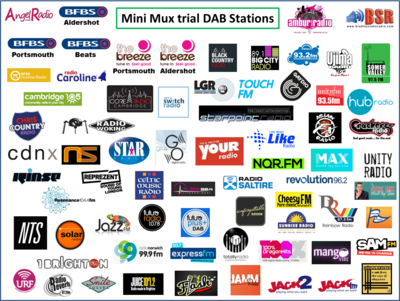
- There are currently over 90 (see image right) small commercial and community stations broadcasting in the 10 trial areas of the Ofcom small-scale DAB trials which have been extended by 2 years.
- Angel Radio announced a further expansion to the number of stations on the Portsmouth DAB Mini-mux to 18 with more than half of the stations (10) broadcasting in DAB+. There are 15 stations broadcasting in the Manchester trial and Niocast have a waiting list and are planning to launch additional services.
- DCMS are progressing plans for a new licencing framework to support the extension of the existing trials and expansion to other areas across the UK.
Small-scale DAB licencing consultation
In January 2018, DCMS published the small-scale DAB consultation document (consultation document here), accompanied by a press release headed ‘Government to help commercial and community radio to go digital.’ (press release here).
The press release highlights the progress made by digital radio and the opportunity offered by small-scale technology to enable hundreds of local commercial and community stations to broadcast on DAB for the first time.
The consultation ran for 8 weeks from 4 January to 28 February 2018 and covered 12 key questions relating to community stations and digital licences, ownership of small scale radio multiplexes, the size of the multiplex area, the duration of the licences, BBC access to small-scale DAB and Ofcom’s duty to consider local commercial impacts on local multiplexes.
DCMS have said that their aim is to have new licensing arrangements in place by the end of the year. It is likely that during this period they will take measures to extend the existing trial area small-scale multiplexes whose licences expire in the first half of 2018.
In July 2018 Ofcom announced that they would be taking expressions of interest from people wanting to operate small-scale DAB multiplexes and radio stations wanting to broadcast on them in the future. The closing date for the submission of expressions of interest is 21 September 2018.
United Kingdom regulation and spectrum
Last update: 06.05.2022 - older versions
Digital Radio and Audio review
The Digital Radio and Audio Review was commissioned by the government in February 2020 with the objective of assessing likely future trends in listening and to make recommendations on ways of strengthening UK radio and audio. Its report was published in October 2021, and describes sector commitments and options for future government support.
The UK government's response to the review was published in April 2022, and focuses on the recommendations for specific government action. Digital Radio UK summarises the response
Digital Radio UK's summary of the response in relation to DAB is available here.
Digital Radio Switchover
In its response, the government agreed with the Digital Radio and Audio Review's main conclusion that there should be no formal switch-off of analogue radio services before 2030 at the earliest, and notes that the ongoing decline of analogue listening makes it appropriate to consider updating elements of the legislative framework to support a smooth transition of services away from analogue in due course. Government also agreed that government and industry should look at this again in 2026.
Small-scale DAB
Ofcom reinforce that the primary focus of the programme is to enable community stations , small commercial stations and new entrants to have an affordable pathway to terrestrial digital radio. That is the priority for the use of available DAB spectrum but Ofcom have said that later in the programme they will consider the requirement and opportunity for additional local DAB multiplexes where there is evidence of demand and spectrum availability . The criteria Ofcom have set for the small scale multiplexes and their services is the consumer benefits of social gain, and local community accountability and participation. Ofcom have confirmed that to be eligible for the new Community Digital Social Programme ( C-DSP) licenses the services will have to have studios based in the coverage area .They have stipulated a minimum of three C-DSP services on each multiplex to be community radio stations . Ofcom decided to maintain their position that coverage of the small-scale multiplexes should not exceed 40% of the population of the given area.
United Kingdom marketing
Last update: 13.07.2020 - older versions
2020 campaign
Digital Radio UK, the organisation charged with overseeing the promotion of digital radio in the UK, launched a major campaign in summer 2020 called 'Radio's Digital Revolution'. The campaign is aimed at helping retailers and manufacturers communicate to consumers and listeners about digital radio.
2018 campaigns
Ads have been playing across commercial stations since the end of May, with trails also playing across BBC national and local stations for two weeks in June. The campaign has highlighted offers on DAB digital radios at UK retailers, promoted the summer’s great sports and music content, and communicated the many ways to listen to digital radio including smartphone and voice-controlled speaker.
Northern Ireland promotion
Digital Radio UK is partnering with broadcasters and retailers in Northern Ireland to run a coordinated promotional campaign for digital radio including converting cars to digital. The campaign will focus on localised communications, including on-air ads, competitions and editorial; as well as retail point-of-sale. The project is based on the recent Surrey Car Conversion Pilot and will focus on digital radio devices for the home and car.
2017 Christmas campaign
Digital Radio UK worked with the BBC to create the campaign which is focused on gifting and recalls the familiar poem ‘T’was the night before Christmas’ to reveal a ‘world of digital radio lay under the tree’. The campaign highlights the many ways to give the gift of digital radio such as connected and voice-controlled speakers, as well as a DAB digital radio, and the commercial activity also includes an in-car gifting message. This phase of the campaign will play on commercial stations from 4 – 24 December, and across BBC stations from 11 – 24 December 2017. Listen to the campaign here.
United Kingdom overview
Useful Links
Blog Posts
Latest United Kingdom news
19.10.2026
GB Media Limited is announcing the launch of GB Music Radio – a new 24-hour digital radio station dedicated exclusively to artists from Great Britain and...
16.10.2026
The countdown to Christmas has officially begun as Global launches Classic FM Christmas, the first-ever UK radio station dedicated entirely to Christmas...
15.10.2026
A new radio station offering visitor information and local stories is launching on the East Hampshire small-scale DAB multiplex. Hampshire Tourist Radio...